Quick Guide
So you've heard the name, maybe seen a picture—a train snaking around a giant curve carved into a Pennsylvania mountainside. It pops up in documentaries, history books, and travel blogs. And you're left wondering, what's the big deal? Why is the Horseshoe Curve so famous, really? Is it just a pretty view, or is there more to the story?
Let me tell you, it's way more than just a curve. I thought the same thing before I dug into it. I figured it was just another old railroad thing. But the more I learned, the more I realized this place is a cornerstone of American history, a mind-boggling feat of engineering, and a living museum all rolled into one. Its fame isn't an accident. It was earned.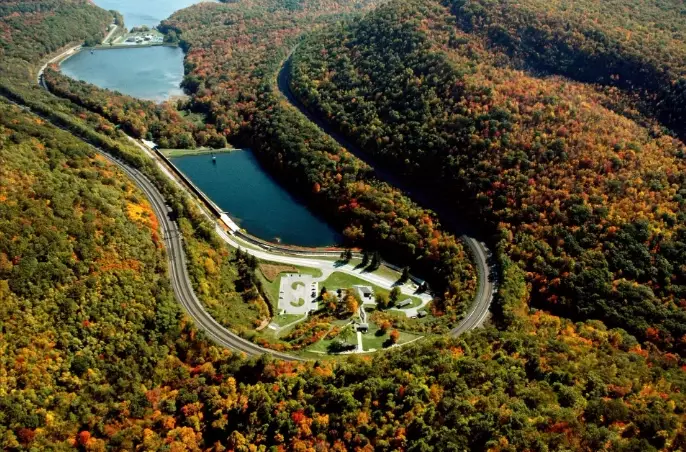
The Core Reason: Solving an Impossible Problem
To get why the Horseshoe Curve is famous, you have to understand the problem it solved. Picture the Allegheny Mountains in the mid-1800s. They were a massive, stubborn wall standing between the industrial east and the expanding west. The Pennsylvania Railroad needed to get its trains from Philadelphia to Pittsburgh and beyond.
The direct route? Straight up and over. Impossible for steam engines of the time. The grades were too steep. A train might just stall out or, worse, slip backward. They needed a workaround, a way to make the climb gradual enough for a heavy locomotive to handle.
The engineer, a guy named J. Edgar Thomson, had a brilliant, simple idea. If you can't go over it, go around it. But not just a little bend. A massive, 220-degree horseshoe-shaped curve that would let the track gain elevation slowly, like a spiral ramp in a parking garage, but on the side of a mountain.
The Numbers That Made It Famous
- Grade: Reduced a punishing, impossible slope to a manageable 1.45% grade. This was the magic number.
- Length: The curve itself is about 2,375 feet long.
- Elevation Change: It climbs roughly 122 feet from one end to the other.
- Construction: Built almost entirely by hand by thousands of workers (mostly Irish immigrants) with picks, shovels, black powder, and horse-drawn carts. No bulldozers, no dynamite (as we know it). They moved millions of cubic yards of earth and rock.
When it opened in 1854, it was an instant sensation. It cut the travel time across Pennsylvania dramatically. Suddenly, moving goods and people became faster, cheaper, and more reliable. It wasn't just a railroad curve; it was an economic artery that started pumping life into the heart of the country. That's a foundational part of why the Horseshoe Curve is so famous—it was a direct catalyst for national growth.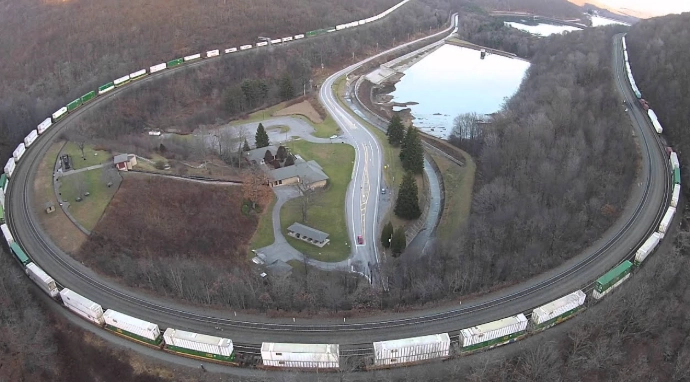
Fame Through War and Industry
Fame often gets cemented in times of crisis. For the Horseshoe Curve, that crisis was World War II. This is where its strategic importance became a matter of national security.
The Curve was the single most critical rail chokepoint for moving war material from the industrial Midwest to the East Coast ports. Tanks, planes, ammunition, troops—almost all of it flowed through this one spot in Pennsylvania. The military and the railroad knew it was a giant target.
They stationed an entire army battalion there to guard it 24/7. We're talking anti-aircraft guns, patrols, barbed wire fences. It was considered so vital that it was allegedly one of the most heavily defended non-combat locations in the entire United States during the war. German saboteurs were known to have plotted against it. That kind of drama isn't just history; it's the stuff of legends, and it permanently etched the Curve's importance into the national consciousness.
Even after the war, its fame persisted because it just kept working. Day in, day out, for over 170 years now. It's a testament to the quality of that original 1850s engineering. While other lines have been abandoned or rerouted, the Horseshoe Curve remains a vital, active mainline for Norfolk Southern Railway. You can see modern freight trains, sometimes over a mile long, being pulled by powerful diesel locomotives (and occasionally even vintage steam excursions) around the same curve built for tiny steam engines. That continuity is powerful.
What's It Like to Actually Visit? The Visitor Experience
Okay, so the history is solid. But part of its modern fame is that you can actually go and witness this living history. The Horseshoe Curve National Historic Landmark, operated by the Railroaders Memorial Museum in Altoona, is the place to go.
Let's be real for a second. If you're not a railfan, the idea of watching trains might sound, well, a bit dull. I had my doubts. But there's something unexpectedly mesmerizing about it. It's the scale. You're standing on this hillside looking down at this perfect, geometric curve, and then you see a tiny train appear in the distance. Over the next ten minutes, you watch this massive, rumbling machine slowly traverse the entire arc right below you. It's slow-motion ballet with 20,000 tons of steel. It's oddly peaceful and powerful at the same time.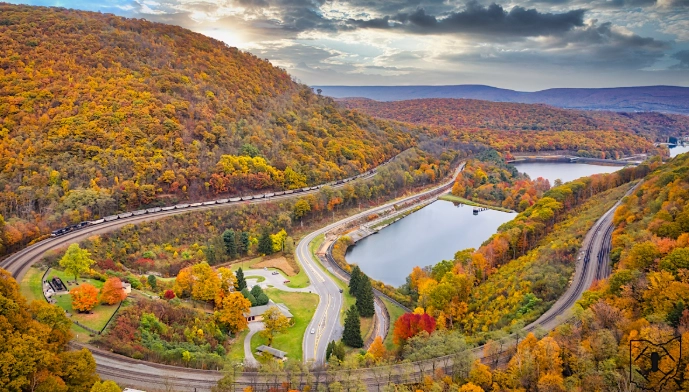
The site itself has a funicular incline railway (a little cable car) to take you from the visitor center down to the main observation area. Thank goodness for that—walking up that hill would be a workout! Up top, there's a small but informative museum in the old historic visitor center building that gives you the context you need.
Planning Your Visit: The Practical Stuff
Best time to go? Weekdays are usually better for consistent train traffic, as that's when most freight moves. Late morning through afternoon is often active. But honestly, there's no guarantee—it's a real railroad, not a show schedule. Part of the charm is the anticipation.
What will you see? Mostly long freight trains—double-stacked containers, coal, automotive carriers, tank cars. The variety is part of the fun. If you're lucky, you might catch a special excursion with a historic steam locomotive, which is absolutely breathtaking against that backdrop.
Is it worth it? If you have any interest in history, engineering, or just seeing something uniquely American, absolutely. It's not an all-day affair, but couple it with the main Railroaders Memorial Museum in Altoona, and you've got a fantastic day trip.
One minor gripe? The mosquitoes up on that hillside can be ferocious in the summer. Bring bug spray. Seriously. And the trains can be loud—a deep, ground-shaking rumble that's part of the authentic experience.
How It Stacks Up: Horseshoe Curve vs. Other Rail Feats
People often ask how it compares to other famous railroads. It's a fair question. Let's break it down in a way that highlights what makes the Curve special.
| Railroad Feature | Location | Key Claim to Fame | Why Horseshoe Curve is Different |
|---|---|---|---|
| Horseshoe Curve | Altoona, PA, USA | Masterpiece of civil engineering to conquer a mountain grade; continuous operation since 1854; vital WWII role. | Its fame is rooted in practical problem-solving for a major railroad. It's not the highest, longest, or steepest—it's the smartest solution that became irreplaceable. |
| Gotthard Base Tunnel | Switzerland | World's longest and deepest railway tunnel, a modern marvel of tunneling tech. | The Curve is the opposite approach. Instead of burrowing through the mountain with 21st-century tech, it creatively went around it with 19th-century muscle and brains. |
| Trans-Siberian Railway | Russia | Sheer epic length and scale, crossing continents. | The Curve's fame is about a single, critical point on a route. It was the linchpin. The Trans-Siberian is famous for its totality; the Curve is famous for being the indispensable piece. |
| C&O's Big Bend Tunnel | West Virginia, USA | Famous for John Henry legend; manual labor vs. machine. | Both are 1850s engineering. The Curve's legend is about collective ingenuity and lasting utility. Big Bend's legend is more folkloric, about a man vs. machine moment. |
See the pattern? The Horseshoe Curve isn't about breaking extreme records. Its fame comes from being the perfectly balanced solution—elegant, efficient, durable, and historically pivotal. That's a different kind of greatness.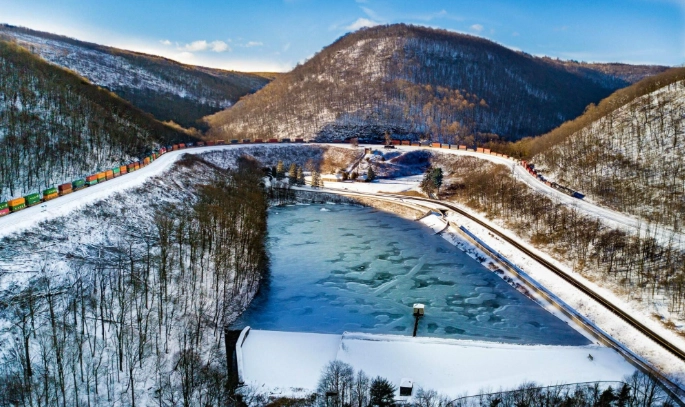
Answers to the Questions You're Actually Searching For
When people type "Why is the Horseshoe Curve so famous?" into Google, they usually have a bunch of related questions simmering underneath. Let's tackle those head-on.
Is it the biggest or sharpest railroad curve in the world?
Nope, not even close. There are tighter curves on streetcar lines and in mountain passes. Its fame isn't from being the most extreme. It's from being the most important curve. It was the right solution in the right place at the right time in history. Extreme doesn't always mean significant.
Can you still see trains there?
Absolutely. That's the whole point! It's not a relic. It's a working, buzzing, essential part of the North American rail network. On a busy day, you might see a dozen or more trains. The Railroaders Memorial Museum's website sometimes has tips on current activity.
Why is it a National Historic Landmark?
This is a big one. The U.S. National Park Service designates Landmarks for places of exceptional national significance. The Curve earned this in 1966 (you can see the official designation on the NPS website). The citation highlights its engineering genius and its crucial role in transportation and economic history. It's not just old; it's nationally important.
How did they build it without modern machinery?
This question is at the heart of its fame. Brutal, manual labor. Thousands of workers, mostly Irish immigrants, using hand tools, horses, carts, and black powder for blasting. They worked in all weather, on a dangerous mountainside. The cost was high in both money and human effort. When you look at it, you're seeing a landscape literally shaped by human hands. The Pennsylvania Historical & Museum Commission has details on the construction era that really drive this home.
First, it was a stroke of engineering genius that solved a geographic nightmare. Second, it became the economic lifeline for a nation moving west. Third, it turned into a strategic wartime asset defended like a fortress. And fourth, it has endured—still working, still vital, and completely accessible for us to go and appreciate.
Its fame is the fame of a quiet workhorse that became a legend. It didn't need flashy records. It just needed to work, and work perfectly, for generations. And it does. Next time you see a picture, you'll see more than just a train on a curve. You'll see a key piece of the American story, still in motion.
Maybe that's the simplest answer. Why is the Horseshoe Curve so famous? Because it mattered then, it matters now, and seeing it makes you feel that connection to the past in a very direct, rumbling, tangible way. Few historical sites offer that.
Reader Comments