Quick Navigation
Let's be honest for a second. When you first hear "Horseshoe Curve Pennsylvania," you might picture, well, a curve. A bend in some old railroad tracks out in the woods somewhere. I thought the same thing before my first visit. How interesting could it really be?
I was completely wrong.
Standing on that hillside in Altoona, watching a mile-long freight train slowly navigate the 220-degree arc below, you get it. This isn't just a curve. It's a living, breathing piece of American history. It's a solution to a massive problem that changed the country. And honestly, it's just plain cool to watch. The sheer scale of it is something photos never do justice. The sound of the engines straining, the rhythmic clatter of the wheels on the joints—it gets under your skin.
This guide isn't going to just give you the dry facts. I want to tell you why the Horseshoe Curve matters, what it feels like to be there, and everything you need to know to plan your own trip. Whether you're a hardcore railfan with a scanner or a family looking for a unique afternoon out, there's something here for you.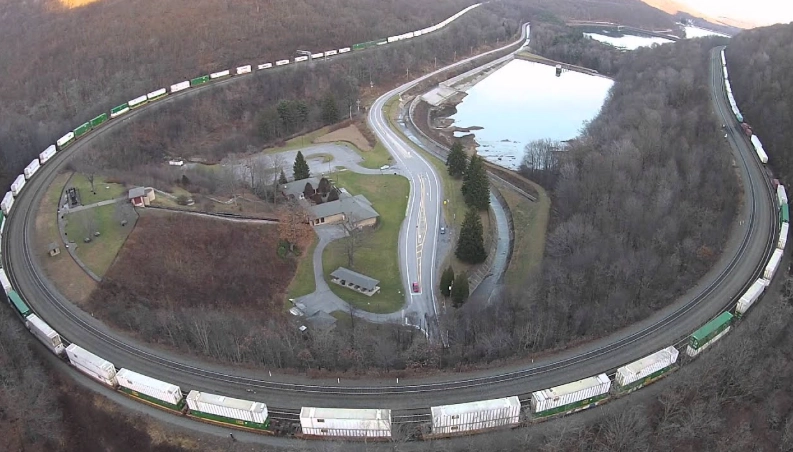
The Story Behind the Bend: Why Horseshoe Curve Exists
To really appreciate the Horseshoe Curve, you have to understand the problem it solved. In the mid-1800s, the Pennsylvania Railroad (PRR) was pushing west, but they hit a wall. Literally. The Allegheny Mountains stood in the way, presenting a grade so steep that the locomotives of the day simply couldn't handle it. A direct route was impossible.
The chief engineer, a man named J. Edgar Thomson, had a brilliant and relatively simple idea. Instead of fighting the mountain head-on, why not go around it? By tracing the contour of a nearby valley—Kittanning Point—his team designed a route that would gain elevation gradually. The result was the iconic horseshoe shape.
Construction was a beast. It took about 450 workers, mostly Irish immigrants, using picks, shovels, black powder, and sheer muscle from 1850 to 1854. They moved an unbelievable amount of earth and rock. When it opened on February 15, 1854, it was an instant success. The grade was reduced to a manageable 1.8%, which seems tiny but made all the difference. It immediately became the main line for moving people and goods between the east coast and the Midwest.
Think about that for a second. This curve shaped the economic destiny of the United States.
Its strategic importance was so great that during World War II, the US government stationed an entire battalion of soldiers there to guard it from potential sabotage. It was that critical to the war effort. Today, it's still a vital artery for freight, operated by Norfolk Southern. The engineering of the Horseshoe Curve Pennsylvania was so spot-on that its basic alignment has never needed major alteration. Now that's good planning.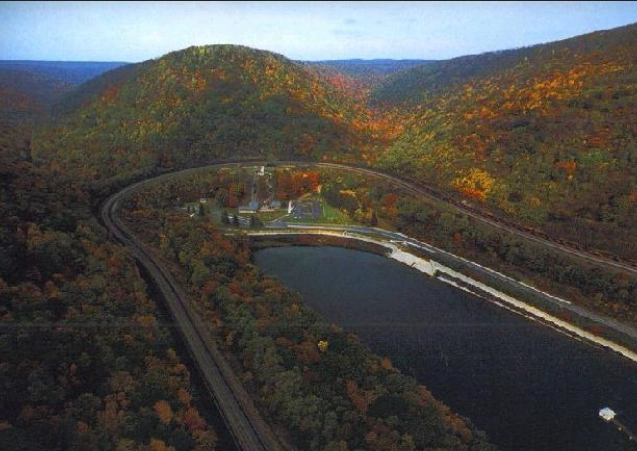
Planning Your Visit: The Nitty-Gritty Details
Alright, let's get practical. You're convinced it's worth seeing. How do you actually do it?
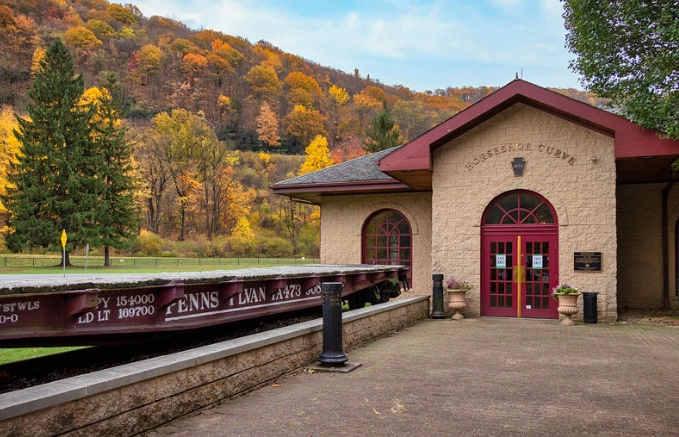
The site is operated by the Altoona Railroaders Memorial Museum. You start at their museum in downtown Altoona to buy your ticket and catch the shuttle. You can't just drive up to the Curve itself anymore—access is controlled via a funicular incline railway (a fancy cable car) that takes you from the visitor center up to the famous overlook. The ride itself is part of the experience, offering great views on the way up.
Here’s a quick table to break down the essentials:
| What You Need to Know | Details |
|---|---|
| Official Name & Location | Horseshoe Curve National Historic Landmark, Altoona, PA. |
| Operating Body | Altoona Railroaders Memorial Museum (ARMM). |
| Primary Access | Purchase tickets at ARMM, take shuttle to base of incline, ride funicular to overlook. |
| Best Time to Visit | Weekdays (less crowded), late morning or early afternoon for good light. Trains run 24/7. |
| Key Thing to Bring | Camera, binoculars, sunscreen/water (exposed hilltop), jacket (it can be windy). |
| Time to Allocate | At least 2-3 hours total (including museum and shuttle time). |
One minor gripe? The gift shop at the top is pretty small and the selection is a bit limited. If you're a serious collector looking for rare memorabilia, you might be disappointed. But for kids (or kids at heart) wanting a train whistle or a postcard, it's fine.
What You'll Actually See and Do Up There
The main event is, of course, the overlook. You're on a paved, fenced platform high above the curve. The view is panoramic. You can see the entire magnificent loop, the twin tracks, and the dense Pennsylvania forest all around.
Then you wait. And that's the fun part. Will it be a slow-moving coal train? A fast intermodal freight with colorful containers? A Norfolk Southern heritage unit? You never know. There are informational signs that explain what you're looking at, the different types of trains, and the history. Sometimes, if you're lucky, a staff member is up there with a radio and can tell you what's coming next.
It's not a passive experience. You find yourself guessing what the next train will be, pointing out details to your friends, and just soaking in the industrial ballet below. For kids, there's a chance to run around a bit (safely, within the fenced area) and burn off some energy while waiting.
Capturing the Perfect Shot: Photography Tips
Let's talk photos. Everyone wants a great shot of the Horseshoe Curve Pennsylvania. The classic view is from the overlook, looking down the length of the curve. That's a must-have.
- Lens Choice: A wide-angle lens (24mm or wider on a full-frame camera) is perfect for capturing the whole sweep. A zoom lens (70-200mm) is great for isolating individual locomotives or cars as they pass specific points.
- Lighting: Morning light hits the curve from the east, afternoon from the west. I personally prefer late afternoon for warmer tones. Overcast days are actually great—they eliminate harsh shadows and give even lighting.
- Patience is Key: Composition is easy. The hard part is waiting for a train to be in the exact right spot. Don't just take one shot as the engine enters the curve. Take a series as it progresses through the entire bend. That way you can pick the best one later.
- Beyond the Overlook: The official overlook is the easiest spot, but it's not the only one. There are hiking trails in Gallitzin State Forest that lead to other vantage points. These require more effort and planning (and good hiking shoes), but they offer unique, less-photographed perspectives. The PA DCNR website has trail maps if you're feeling adventurous.
Remember, the train doesn't care about your photo op. It moves at its own pace.
Answering Your Questions (The Stuff You Actually Want to Know)
Beyond the Curve: What Else is Nearby?
You're in the heart of Pennsylvania railroad country. Making a day or weekend of it is easy.
- The Altoona Railroaders Memorial Museum: I've mentioned it twice because it's that good. It's housed in the former PRR master mechanic's building. The exhibits on the workers—the "railroaders"—are moving and well-done. You can walk through a classic dining car and see massive steam locomotives up close.
- The Allegheny Portage Railroad National Historic Site: About a 20-minute drive away. This was the *other* ingenious solution to crossing the mountains—a series of inclined planes before the Horseshoe Curve was built. It's run by the National Park Service and offers a completely different piece of transportation history. Their visitor center is excellent.
- Gallitzin Tunnels: The town of Gallitzin, just north of Altoona, is built around tunnels. You can visit the Gallitzin Tunnels Park & Museum for another ground-level perspective on mountain railroading.
- For the Family: If you need a non-railroad break, Lakemont Park and the historic Leap-The-Dips wooden roller coaster are nearby.
So, should you go? If you have any interest in history, engineering, or just seeing something truly unique, the answer is yes. Pack your patience, your camera, and maybe a snack. Find a spot on the railing, listen for the distant horn, and watch as history rolls by, one car at a time.
It's more than just a curve. It's a testament to human ingenuity, and it's still doing its job over 170 years later. That's pretty amazing when you think about it.
Reader Comments